Depending on where you are coming from, Norwegian has a lot of vowels. Nine vowels, if we don’t distinguish short and long vowels or diphthongs (glide vowels). If Arabic is your native language, that’s going from 3 to 9. For many Romance languages, that’s 5 to 9. Two of the more unusual vowels in Norwegian are Y and Ø. These are somewhat unusual, despite there being similar sounds in many languages.
Over the years, in trying to explain this, I’ve found one way that really works. Consider them as pairs with other vowels. I and Y are a pair, and E and Ø are a pair. Now, when making Y, we will use the I sound as the basis, and make one alteration in order to pronounce it. The same for Ø; we’ll use E as the basis and make one change.
Note: While I and E are fairly universal in pronunciation across languages, English is the notable example here. I as in hill (not as in time) and E as in bet (not as in me).
The distinction between these pairs is roundedness. Otherwise, they should be more or less the same (though this may depend on your pronunciation of I and E. When we want to make the Y or Ø sound, we have to make a “kissy face” as we do it. Yes, it sounds very silly, but it works.
It should look like the left picture here (protruded rounding):
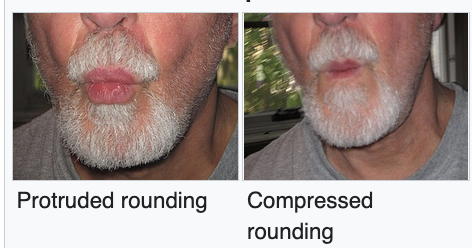
If we try to make an E sound, but with the “kissy face” (protruded rounding), we should end up with Ø. The same applies with I/Y, try to make an I, but make a “kissy face” as you do it and you should end up with Y. That’s the trick!
Extra Credit: German has Ü and Ö, which are very similar, but use compressed rounding rather than protruded rounding. This is more evident when comparing Norwegian Y and German Ü, than with Norwegian Ø and German Ö (at least for me).